
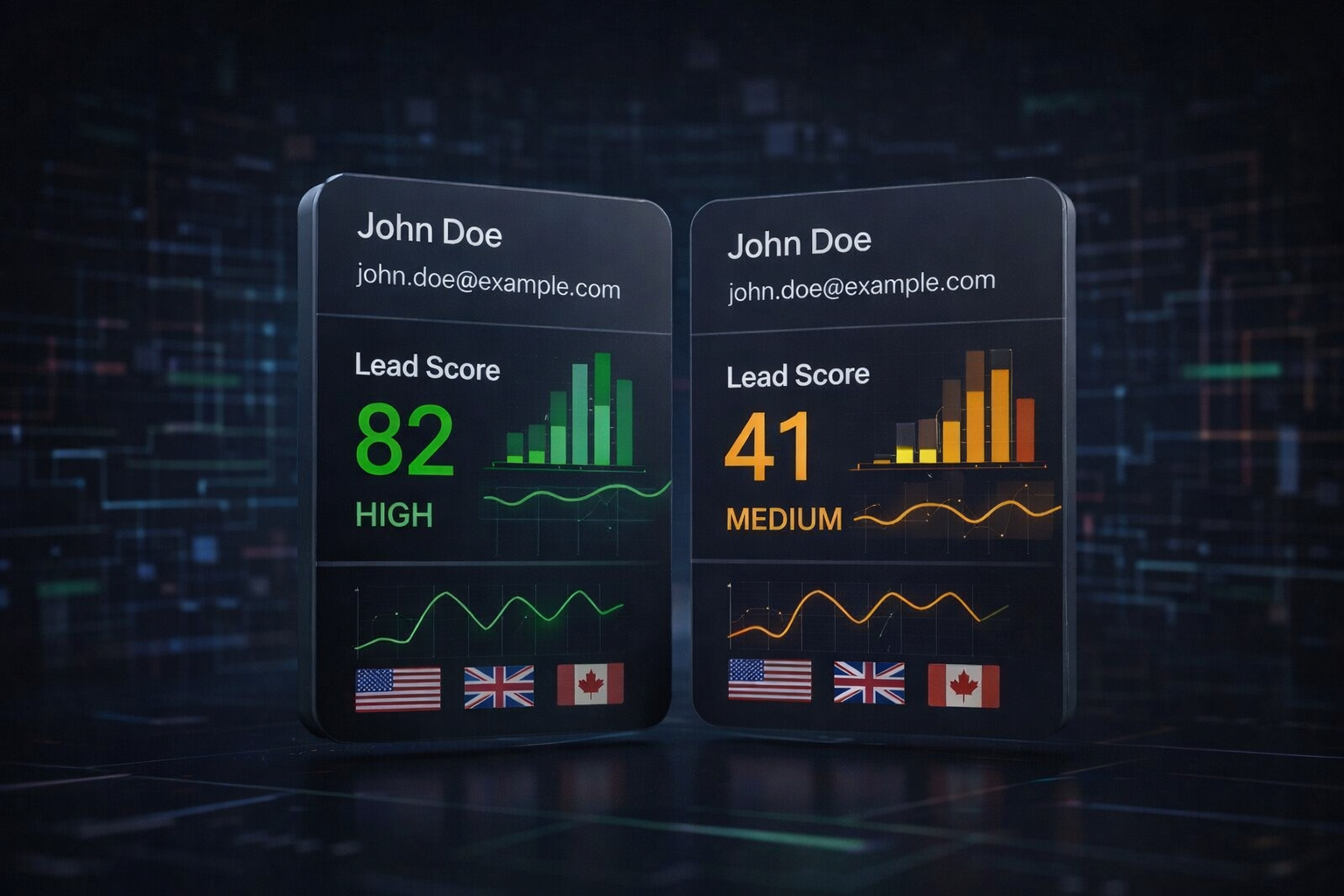
Most sales teams believe lead scoring solves lead quality.
It doesn’t.
In many cases, lead scoring fails before the first sales call even happens — and not because the lead is bad, but because the score can’t be trusted.
The same lead, different score
This is more common than most teams admit:
- The same lead enters two different CRMs
- Or the same CRM, but a different pipeline
- Or the same setup, but one month later
And suddenly:
- The score changes
- The priority changes
- The decision changes
Nothing about the lead changed.
Only the system did.
When the same lead gets different scores depending on where or when it’s evaluated, operations break.
This isn’t a spam problem
It’s tempting to blame:
- Fake emails
- Low-intent users
- Bad traffic sources
But that’s not the real issue.
Most inbound leads sit in a gray area:
They look valid, behave normally, and pass basic filters — yet they consistently waste sales time.
The problem isn’t detection.
It’s instability.
Scoring drift is the silent killer
Lead scoring systems tend to drift over time:
- Rules are tweaked
- Thresholds are adjusted
- New signals are added
- Old ones lose weight
Each change may seem reasonable on its own.
But collectively, they create a system where:
- Yesterday’s “high-quality lead” is today’s “medium priority”
- Historical comparisons stop making sense
- Sales loses confidence in the score
At that point, teams stop trusting the number — and start relying on gut feeling again.
When scores can’t be trusted, teams pay the price
Unstable lead scoring doesn’t just affect dashboards.
It affects people.
- Sales reps call leads they shouldn’t
- Good leads get buried
- Marketing and sales argue over “lead quality”
- Operations lose predictability
The score exists, but no one fully believes it.
And a score that isn’t trusted is worse than no score at all.
Lead scoring should be a contract, not a guess
At its core, lead scoring should behave like a contract:
- Same input → same result
- Today and six months from now
- Regardless of CRM, pipeline, or internal changes
It should be:
- Predictable
- Stable
- Auditable
Without that stability, every downstream decision is built on sand.
Before the first call, one question matters
Before adding more rules, tools, or automation, it’s worth asking:
Can you trust your lead score before the first sales call?
That question alone explains why so many teams struggle with lead quality — even when the leads themselves look fine.
We’re exploring this problem deeply at LeadFlags.